Outcome: Shipped price-context insights to millions of monthly deal shoppers, reducing external price-checking and increasing confidence to convert directly on Slickdeals.

I led the end-to-end design of Slickdeals' new feature, “Price Intelligence,” for both desktop and mobile web. Price Intelligence makes pricing data accessible to users, transforming the process of onsite deal evaluation and cutting the amount of time users spend outside of Slickdeals, at competitor sites.
We launched the feature to half of Slickdeals’ over 12 million user base in April of 2023, and a month later, rolled it out to the whole audience. I designed a second iteration of the feature as well, which was launched after I left the team in May.
Internal team excitement was high during development and launch. And direct user feedback has been enthusiastically positive.
My Role
Sole Product Designer
Duration
9 Months
Team
Product Manager
Engineers (5)
Overview
Slickdeals is a 23-year-old deal-sharing platform, powered by a community of twelve million shoppers. Users post about deals they find, and fellow deal-seekers vote and comment on the deal.
The posting-and-providing-feedback loop builds UGC that separates Slickdeals from competitors, like Honey and Google Shopping, that are also geared towards helping people shop smarter.
Problem
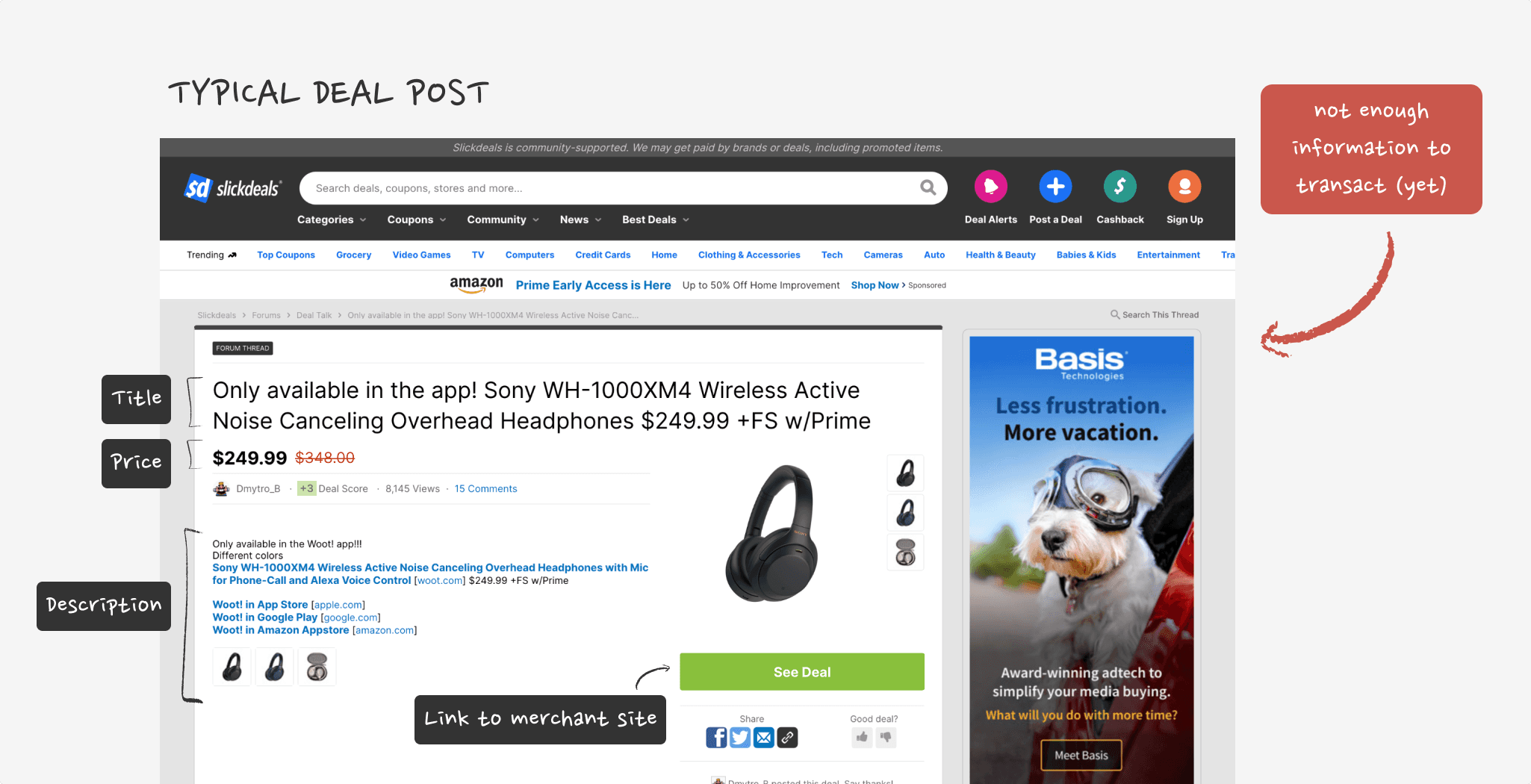
When users find deals they’re interested in, they often leave their current page for two types of searches: product and price research.
Posts always provide instructions on how to get a deal but deal posts by themselves do not provide enough information for a shopper to transact without doing additional research.
Goal
Our primary goal was to fill the price information gap, so users can shop more efficiently and save more.
Our primary KPI was a 25% increase in the average conversion rate for deal posts (i.e. user outclicks from Slickdeals to view products on merchant sites).
We also planned to monitor visits and retention rate, hoping to see an increase in both.
Final Solution
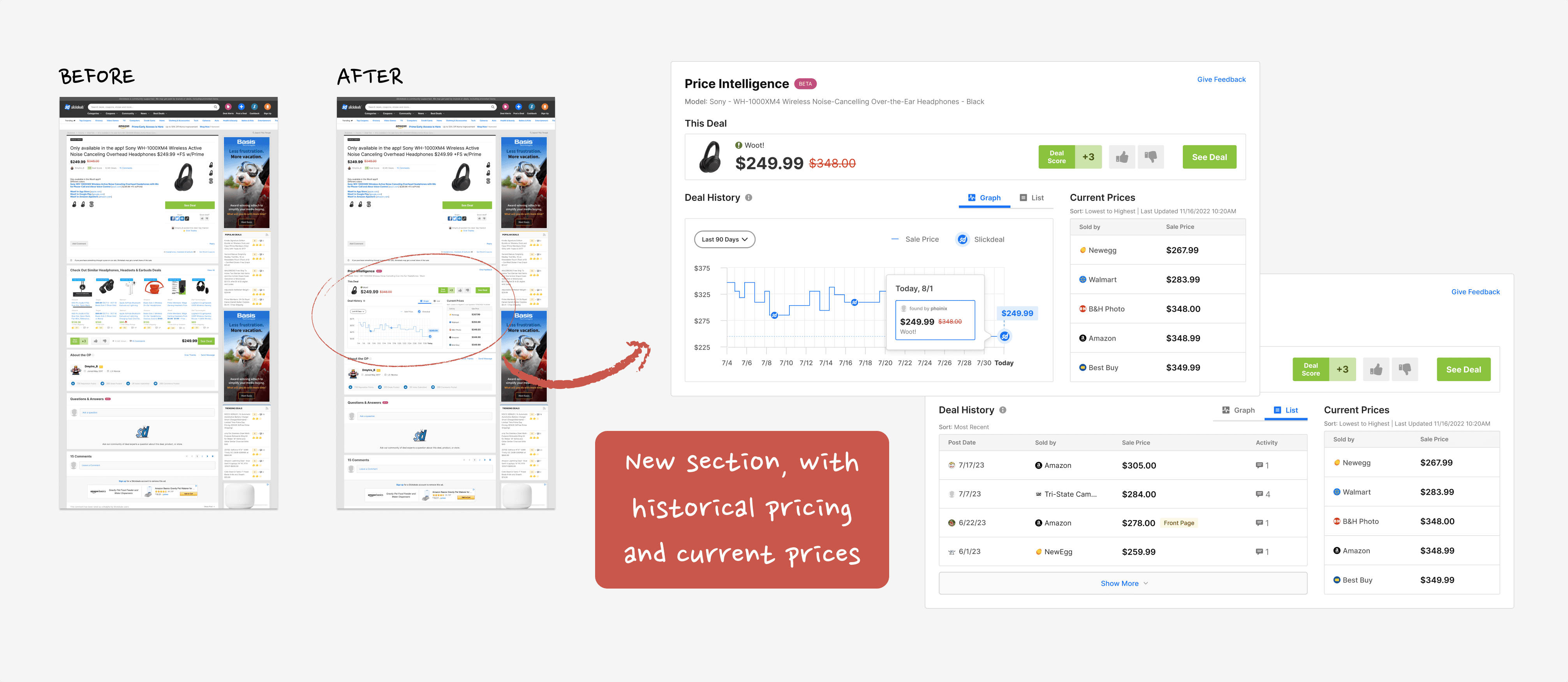
“Price Intelligence” is a new addition to deal posts that allows shoppers to quickly assess a current deal against historical and current prices. Or, in other words, it allows users to answer, “How good is this deal?”
This tool should cut, or at the very least reduce, the amount of external research users perform.
Process
Price Intelligence at Slickdeals was about helping users quickly understand why a deal was worth acting on. Here’s how I approached the problem:
Identified a Confidence Gap: Users frequently left Slickdeals to validate deals elsewhere. The core problem wasn’t discovery—it was trust and confidence at the moment of decision.
Focused on the Signals that Mattered: Instead of surfacing raw price data, I prioritized the few indicators that actually help users judge value—historical context, relative pricing, and clear benchmarks.
Designed for Fast Decision-Making: Deal browsing is high-velocity, so I explored patterns that kept insights lightweight and optional, ensuring they enhanced speed rather than slowed users down.
Tested for Clarity, not Novelty: Through iterative prototyping and feedback, I refined the experience based on whether users could immediately understand why a deal was good.
Shipped Within a High-Traffic Surface: The final solution integrated directly into core deal pages, reaching a large, active audience without disrupting existing behaviors.
This approach resulted in a scalable way to communicate deal value—helping users make faster, more confident decisions while keeping Slickdeals as the place to validate deals, not just discover them.
Final Design
“Price Intelligence” Overview
Shoppers can compare “This Deal” to historical and current prices. The MVP allows them to view the raw data, and make their own assessment.
This Deal
For quick comparison on an already crowded page, this reiteration of important details allows users to compare the price of “This Deal” against other data points easily.

Deal History, Graph View
At a glance, users can—quite literally—see how the current deal price compares to past prices, for a range of dates.

Deal History, List View
For a more detailed view, users can look at past prices in list view, which gives them more context around individual deals, and how good the community viewed them.

Current Prices
Though many assume that the deals on Slickdeals are the best current prices on the web, the ability to see other purchase options is a benefit to those who are newer to the site and don’t quite understand the nuances.
It’s also a pro for more time sensitive purchases or those looking for in-person, nearby shopping options.

This version of the design is live! You can view it here.

Disclaimer: The second launch, with the graph, was built after I left the company, and many changes were made to the design system, so fonts, colors, and spacing are fairly different.
Reflection
Price Intelligence was about helping shoppers confidently evaluate deals—without overwhelming them—inside a dense, legacy interface.
Key Outcomes
Clear user value post-launch: After prioritizing the price history graph, helpfulness scores increased from 6.0 → 6.7 out of 7, with 4× more survey participation—a strong signal of trust and visibility.
More focused MVP through real user signal: Testing showed experienced users valued raw pricing data over summaries or abstractions, which directly shaped scope and launch decisions.
Iterative delivery that paved direction: While early technical constraints limited the first release, feedback from the MVP directly informed a stronger second launch.
Key Learnings
Transparency builds confidence: Users trusted visible price history more than simplified indicators—clarity mattered most.
Focus is an important design skill: In a crowded interface, deciding what not to ship had as much impact as what we built.
Iteration is strategy in practice: Shipping, learning, and adjusting based on real behavior led to a better outcome than waiting for a “perfect” release.
Continue Reading
What to Explore Next
If you’re interested in B2B SaaS and systems-level work, I’d recommend:
Or, head back home to explore my other work.